Start these right away. Some take a few weeks, and you'll need all three before you can fly solo.
FAA medical
Every pilot needs a medical certificate showing they're healthy enough to fly. It's a short exam with a doctor approved by the FAA, called an Aviation Medical Examiner (AME).
Which class? A 3rd class medical is all you need for a private pilot license. If you want to fly as a career, get a 1st class medical instead.
Tip: do this first. If anything in your medical history needs extra review, it's better to find out before you've spent money on flying.
Student pilot certificate
This is your official FAA "learner's permit." You don't need it to take lessons, but you must have it before you can fly solo.
How to get it: create an account on IACRA (the FAA's online application system), then complete and sign the application together with your instructor.
Timing: the card is mailed to you and can take a few weeks, so apply early.
Cost: free.
TSA endorsement
Before flight training begins, the TSA requires your instructor to confirm you're a U.S. citizen. It takes about two minutes.
What to bring: your U.S. passport, or your birth certificate along with a photo ID.
What happens: your instructor checks the document and writes an endorsement in your logbook.
Not a U.S. citizen? You can still learn to fly, but there's an extra TSA approval process first. Reach out before your first lesson.
2 Study
Flying is expensive and studying at home is nearly free. The more you learn on the ground, the less you pay in the air.
Ground school
Ground school teaches the knowledge side of flying: how airplanes fly, weather, navigation, airspace, rules, and more. Most students use an online course they can do at home, on their own schedule.
Required at Altitude Adjustment: every student completes an online ground school. Sporty's Learn to Fly course is the top recommendation.
Ground lessons: you'll also meet with your instructor on the ground to go over what you studied and fill in any gaps.
Start now. Don't wait until you're flying. Students who study between lessons progress faster and spend less.
The written test (officially the "knowledge test") is a multiple-choice exam on everything a private pilot needs to know. You take it on a computer at an FAA testing center.
The basics: 60 questions, 2.5 hours, and you need 70% or better to pass.
Before you take it: you need an endorsement saying you're ready. This can come from your study course (like Sporty's) or from your instructor.
Good for 2 years: you must pass it before your checkride, so don't put it off.
3 Learn to fly
Flying basics
Your first lessons build the core skills every pilot uses on every flight. Each lesson builds on the one before it.
On the ground: preflight inspection, taxiing, and radio communication.
In the air: climbs, descents, turns, slow flight, and stalls (practicing what happens when the wing stops lifting, and how to recover).
Around the airport: traffic patterns, takeoffs, and landings, lots of landings.
Safety: emergency procedures, so you know exactly what to do if something goes wrong.
First solo
The day you take the airplane up by yourself for the first time. It's one of the biggest moments in a pilot's life, and you'll be ready for it.
Pre-solo written test: a short test from your instructor covering the rules and procedures you need to know.
Solo endorsements: your instructor signs off that you're ready, once you're consistently safe on your own.
What it looks like: usually a few takeoffs and landings at your home airport while your instructor watches from the ground.
4 Go places
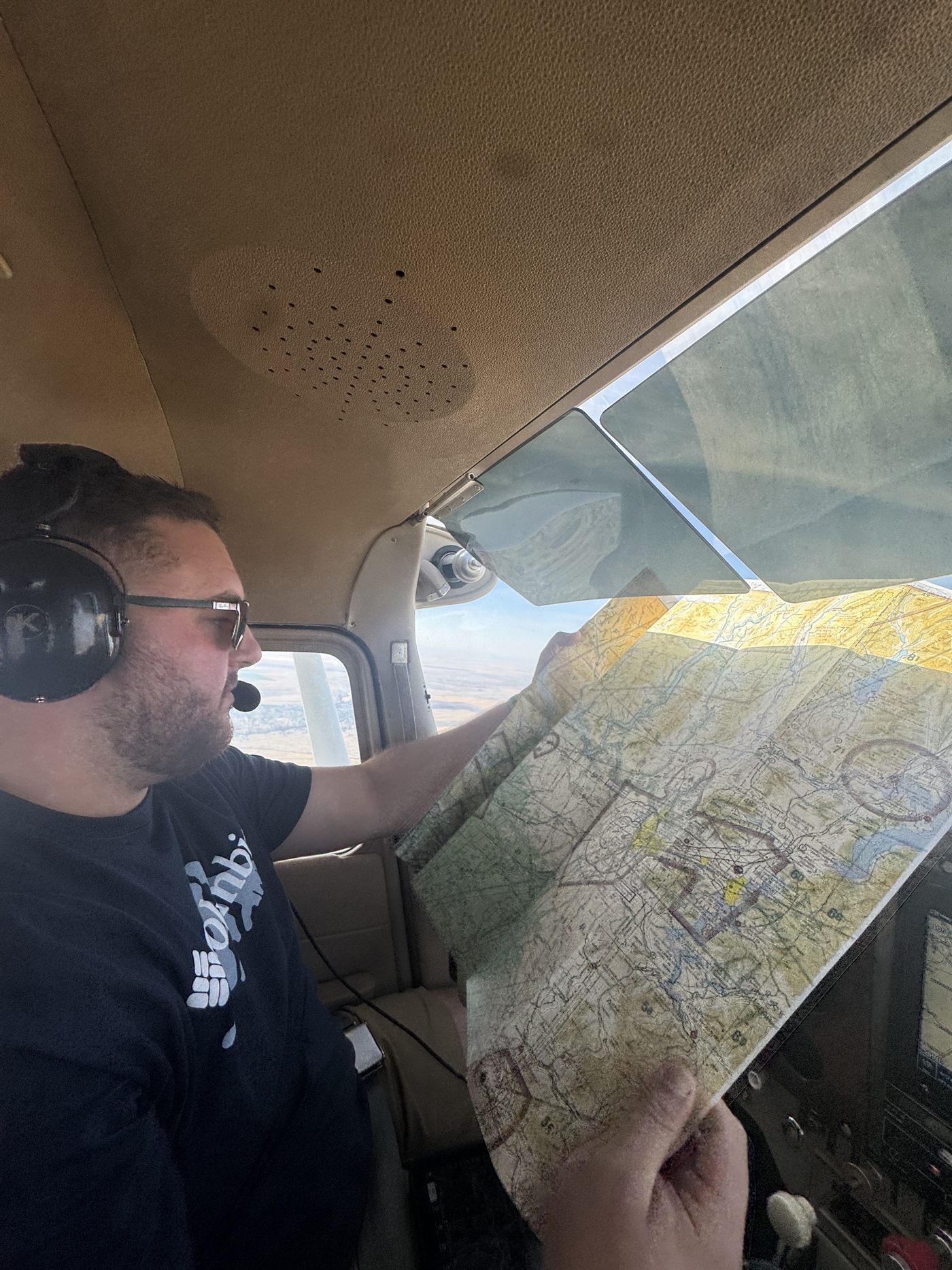
Paper sectional charts are a big part of planning and flying cross-country.
Cross-country flying
In aviation, "cross-country" just means flying to a different airport, usually more than 50 nautical miles away. This is where flying starts to feel like travel.
Flight planning: using charts, weather, and an E6B flight computer to plan your route, time, and fuel.
Navigation: following your plan by looking at landmarks and using instruments.
Diversions: changing plans in the air and heading to a different airport.
Also covered: steep turns and basic instrument flying (controlling the airplane by instruments alone).
Night flying
Private pilots can fly at night, so training includes it. Night flying is beautiful, and it requires a few extra skills.
What's required: 3 hours of night flight training, including one cross-country flight over 100 nautical miles and 10 takeoffs and landings to a full stop.
What you'll learn: airport lighting, night vision, and how to handle the airplane when you can't see the horizon as well.
Solo cross-country
You plan and fly trips to other airports completely on your own. It's a big confidence builder.
Endorsements first: your instructor reviews your planning and signs off before each solo cross-country.
The long one: one trip must be at least 150 nautical miles total, with full-stop landings at three different airports.
✓ Get your license
Checkride prep
Before the real thing, you'll do a full practice run with your instructor, on the ground and in the air.
Practice oral exam: answering the kinds of questions the examiner will ask.
Practice flight: flying every maneuver to checkride standards.
Checkride endorsements: your instructor signs off that you're ready to take the test.
The checkride
Your final exam, given by an FAA-designated examiner. Pass it and you're a private pilot.
Oral exam: a conversation on the ground covering knowledge like weather, airspace, rules, and your airplane.
Flight test: you fly while the examiner watches you perform maneuvers, landings, and emergency procedures.
Minimum flight time: at least 40 hours total. Most students need more, and that's normal.
Want to know what it's really like? Boldmethod has two great articles: the oral exam and the flight.